UAS Systems
The Aedes Network starts with one platform. Designed to be built at a kitchen table. Capable of serving every mission profile that matters.
Aedes Reference Systems
Disposable Aedes MD
Single-Use Autonomous Aerial Platform · 250mm Quad · 2lb Payload · 15–20 km One-Way Range
If the AR-7 is the workhorse, the Disposable Aedes MD is the one-way round. A single-mission autonomous UAV optimized for logistics, sensor deployment, and disaster response where airframe recovery is uneconomical or unsafe. Non-recovery is a feature, not a compromise — releasing weight, complexity, and cost from every subsystem that exists only to support repeated flights. A skilled builder can complete three in a day. No machining. No specialized tools. Just a printer, a soldering iron, and a kitchen table.
Key Numbers
- 1
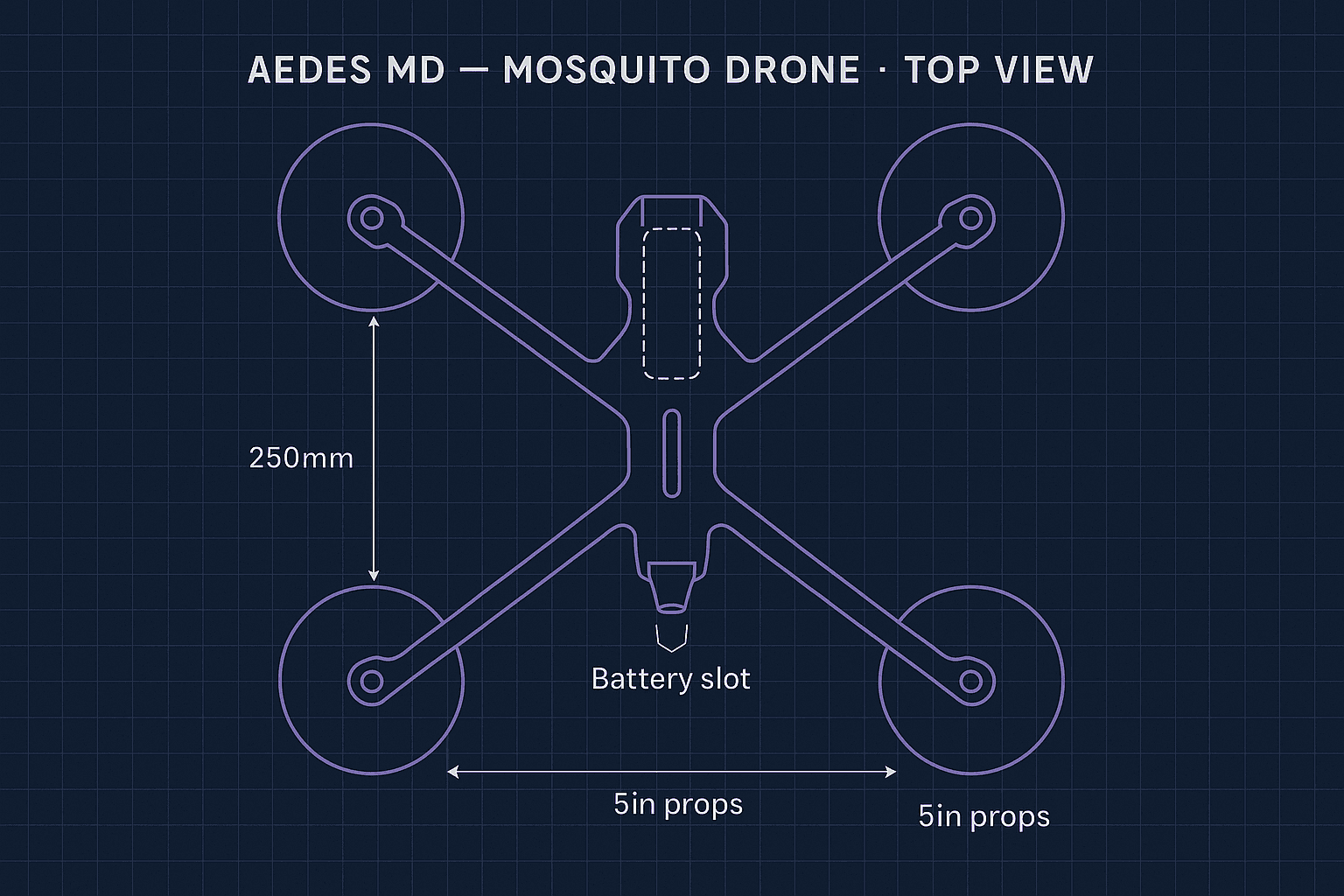
250mm X-configuration quadcopter — same class as Ukraine's most producible platforms, proven at scale for low-cost high-volume production.
- 2
5-inch propellers on 2207-class brushless motors at 35–45 mph cruise speed. Autonomous waypoint flight via ArduPilot — no FPV link required, removing the video transmitter from the BOM entirely.
- 3
Electronics package: F4 flight controller, 4-in-1 ESC stack, GPS, and ELRS receiver for telemetry-only uplink. Single operator can queue and launch 20+ units from a ground control station.
- 4
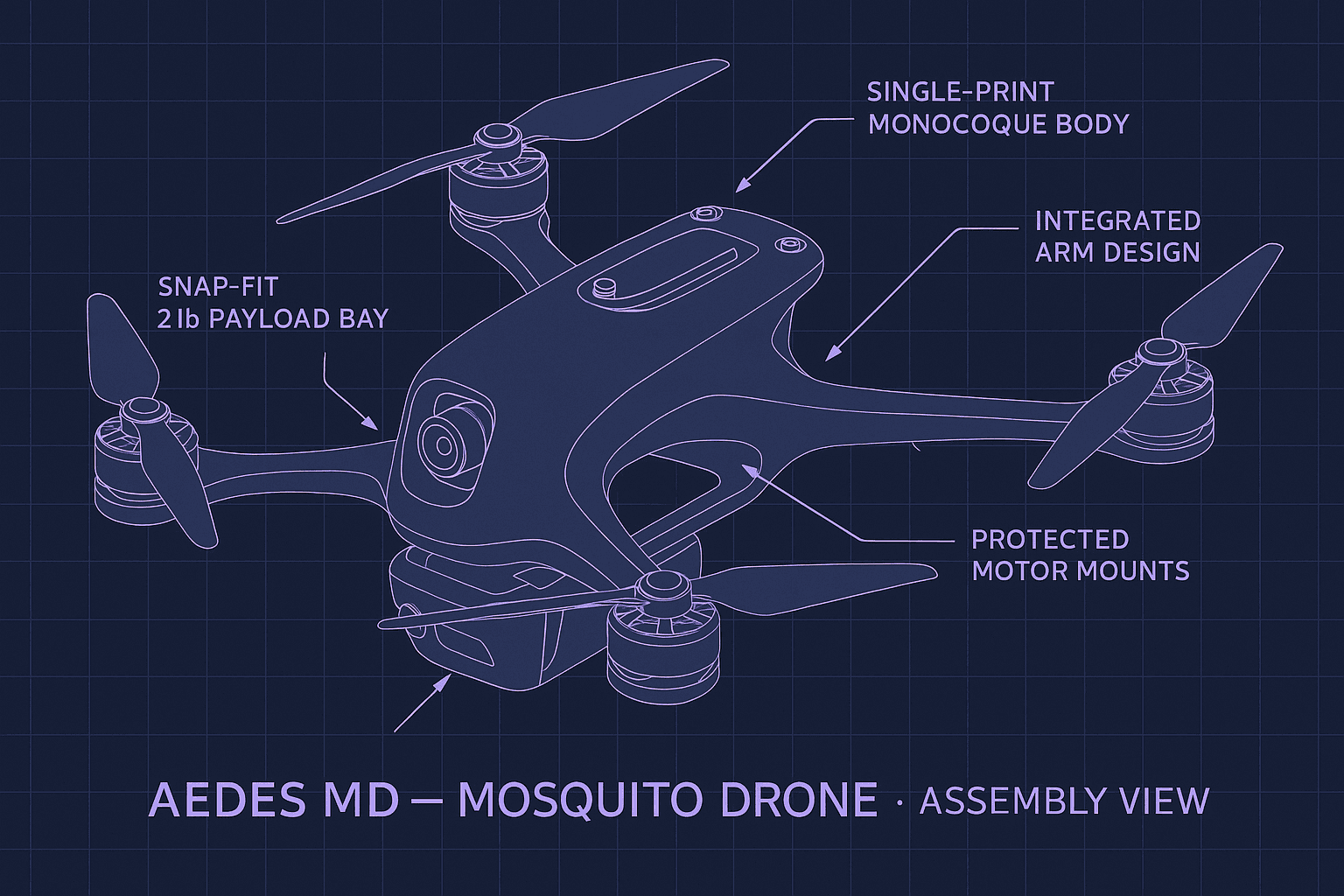
Identical arm geometry — each of 4 arms is the same print/part. Fully parallelizable sub-assembly. Builders specialize on arms, bodies, or electronics stacks and feed a final integration station.
- 5
PLA frame at 15% infill reduces material cost to under $5 per frame. Non-recovery is built into the design — releasing weight and cost from every subsystem that exists only to support repeated flights.
- 1
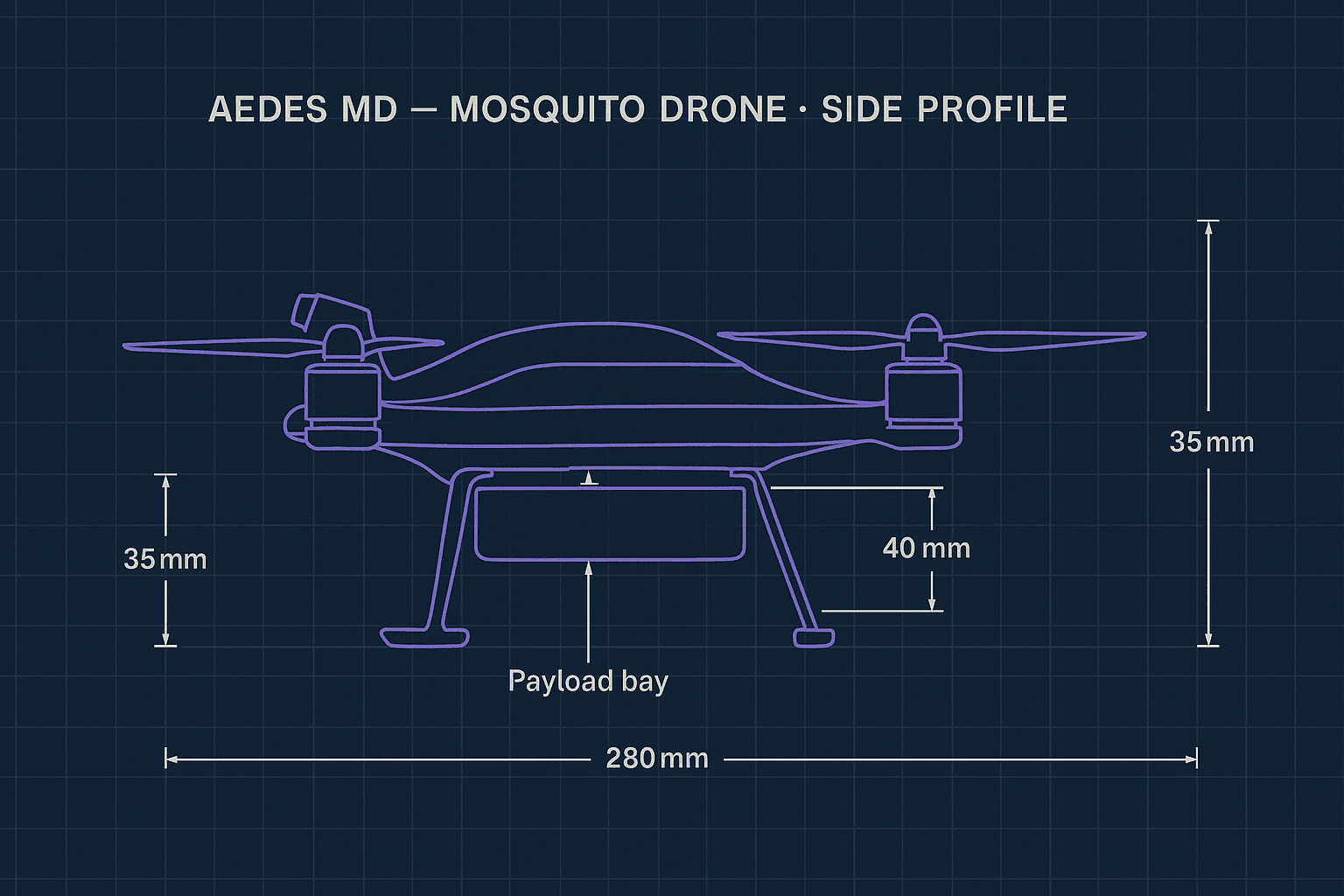
2 lb servo-actuated payload bay on the underside belly. Payload releases autonomously at programmed GPS coordinates — no operator input required at drop point.
- 2
Low-profile body at 35mm height without props. Extremely compact for packaging — a builder can produce and ship a completed unit in a standard flat-rate USPS box.
- 3
No FPV camera. The antenna cluster (GPS mast, ELRS receiver) is mounted for telemetry-only operation. Ground operator receives position and battery status; drone executes mission autonomously.
- 4
Battery mounts flush with the top body panel — standardized XT60 connector, inline LiPo thermal cutoff installed as standard equipment. Post-impact battery fire prevention is a non-negotiable safety requirement regardless of airframe lifetime.
- 5
Total platform weight without payload: approximately 520g. With 2 lb payload: ~1.4 kg. Well within 5-inch motor performance envelope for 25–30 min one-way cruise endurance.
- 1
PLA monocoque body and integrated arms print as a single part on any printer with a 200mm x 200mm build plate. 3–4 hours print time at 15% infill in standard PLA — the cheapest widely-available filament. Material cost per frame: under $5.
- 2
Electronics sub-assembly separates cleanly from frame work: solder motors to ESC, mount FC, pre-load ArduPilot firmware with mission profile template. Sub-assemblies can be stockpiled in advance of frame batches.
- 3
M3 fasteners on motor mounts — a non-negotiable safety standard. A motor shed in flight over populated terrain is a public-safety event regardless of airframe lifetime. All other connections use press-fit or screw terminal where practical.
- 4
Total build time (frame + electronics install + configuration): 3–4 hours per unit for a network builder. A 5-builder cell running multiple printers can sustain 8–10 completed units per day.
- 5
Required tools: 3D printer, soldering iron, screwdriver set. No specialized equipment, no machining. The simplest build process in the Aedes platform family.
Disposable Aedes MD — Full Specifications
Reference specification — subject to refinement through production validation pilots.
AR-7
320mm Quadcopter · Hybrid CF/PETG-CF Frame · 2–3lb Payload · 35–45 Min Endurance
A long-endurance, multi-mission quadcopter engineered for distributed manufacturing. The hybrid-frame architecture — 3D-printed body with pultruded carbon fiber tube arms — resolves the vibration fatigue and heat-soak failures that destroy fully-printed 7-inch builds, while remaining buildable at a kitchen table. Every structural component prints on a consumer-grade printer. Every electronic component is available from domestic suppliers.
Key Numbers

- 1
320mm wheelbase quadcopter in X-configuration — 7-inch class platform with hybrid-frame architecture: 3D-printed PETG-CF body mated to 4 pultruded carbon fiber tube arms.
- 2
7-inch tri-blade propellers on 2806.5 brushless motors. Top speed 70–80 mph clean; 50–60 mph carrying a 2 lb payload. 35–45 minutes cruise endurance unloaded.
- 3
Central body plates house a stacked F7 flight controller and 4-in-1 ESC — accessible from the top for field serviceability. GPS mast mounted separately for clean compass isolation.
- 4
Four identical arm assemblies — each CF tube and motor mount housing is the same part. Builders can specialize in sub-assemblies: one builder on printed body parts, another on tube prep, another on electronics stacks.
- 5
Entire platform ships in a standard flat-rate box without disassembly. Compact footprint fits the kitchen-table build environment from which every Aedes platform starts.
- 1
Quick-release payload rail on the underside center accepts standardized payload modules — swap in under 60 seconds without tools.
- 2
Low-profile body keeps center of gravity stable with payload mounted close to the motor plane. Hybrid-frame geometry places motor mass outboard, reducing pitching moment under load.
- 3
Top-mounted battery tray accepts a 6S 8000mAh LiPo — the primary endurance configuration for 35–45 min unloaded cruise. Li-ion packs are also supported for extended loiter profiles.
- 4
Front-facing camera mount for piloted FPV and ISR profiles; full GPS navigation stack for autonomous waypoint missions. The platform operates in both modes with the same hardware.
- 5
Landing gear provides adequate ground clearance for payload module installation and hot-swap battery access in field conditions.


- 1
Hybrid-frame architecture: 3D-printed PETG-CF body parts handle low-stress structural roles while 16×16mm pultruded CF tube arms carry the high-stress arm loads — eliminating the two primary failure modes of fully-printed 7-inch builds: vibration fatigue and heat soak.
- 2
Body parts: 4 components (top plate, bottom plate, motor mount housings, GPS mast). Total print time 6–8 hours, parallelizable across multiple printers. Material cost: ~$15 in PETG-CF filament.
- 3
Arms: cut 4 CF tubes to 110mm using a $15 pipe cutter — 10 minutes total. Chamfer ends, bolt to motor mount housings with M3 cross-bolts. No machining. A bent CF tube is a $5 swap in 10 minutes.
- 4
Electronics sub-assembly separates cleanly: motors-to-ESC soldering, FC stack integration, and firmware pre-load can be completed before the frame is finished. First build: 12–15 hours. Network builder: 4–6 hours.
- 5
Total component count under 150 parts. M3 fasteners throughout — no snap-fits in any load path. All electronics are off-the-shelf components available from domestic suppliers.
Interchangeable Payload Modules
One airframe. Multiple missions. Payloads snap on and off via the quick-release rail.
EO/IR Camera Module
Electro-optical and infrared imaging for day/night reconnaissance and area surveillance.
Communications Relay Module
Mesh networking radio or UHF/VHF repeater — extends comms range for ground forces or first responders.
Multispectral Mapping Module
Area mapping and terrain modeling for disaster response, infrastructure assessment, and operational planning.
Logistics Delivery Module
Secure payload drop system for medical supplies, small equipment, or critical components to hard-to-reach locations.
Signal Intelligence Module
Passive RF monitoring and spectrum analysis — for authorized government and research applications.
AR-7 — Full Specifications
Reference specification — subject to refinement through production validation pilots.
HX-1 Heavy Hex
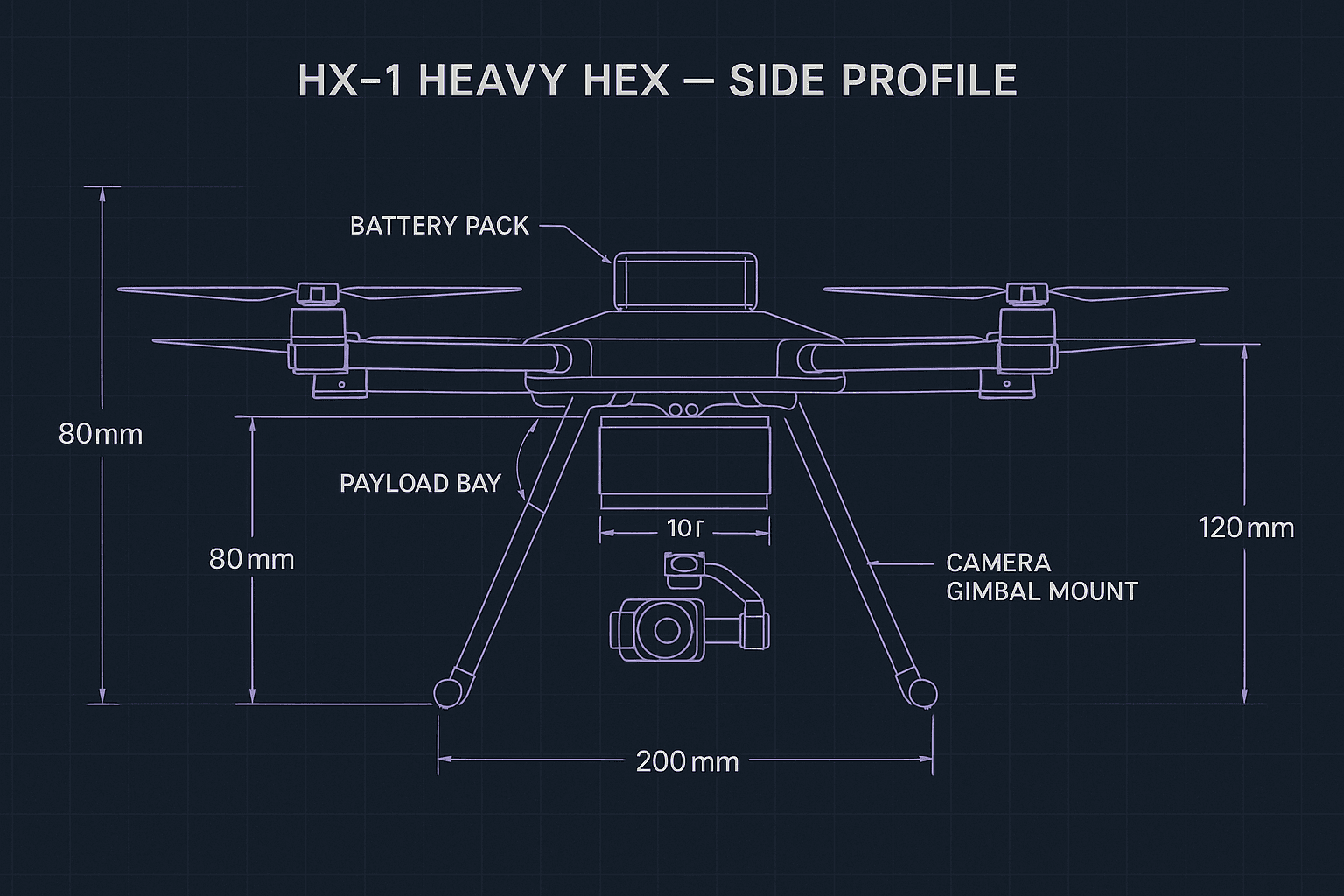
900mm Hexacopter · 10lb Payload · 3D-Printable Airframe
A heavy-lift, multi-mission hexacopter designed from the ground up for distributed manufacturing. Every structural component can be 3D-printed on a consumer-grade printer. Every electronic component is available from domestic suppliers. The entire platform can be assembled — without a machine shop, without a factory — at a kitchen table.
Key Numbers
- 1
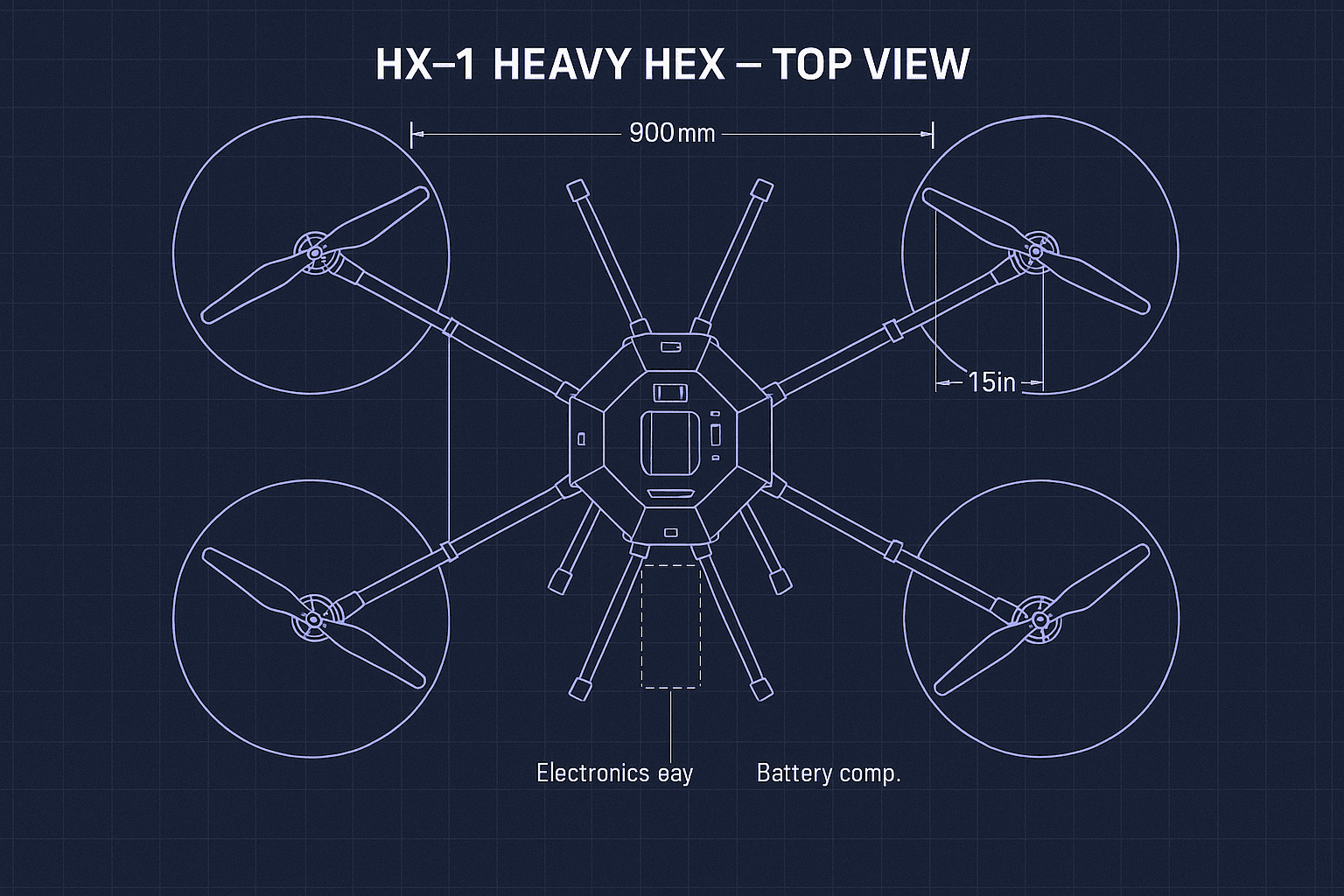
900mm wheelbase hexacopter — 6-motor configuration provides redundancy. Lose one motor and the platform stays airborne.
- 2
15-inch propellers on each arm deliver the thrust-to-weight ratio needed for 10+ lb payload capacity at sustained flight endurance.
- 3
Central octagonal body houses the flight controller, GPS, telemetry, and power distribution — all accessible from the top for field serviceability.
- 4
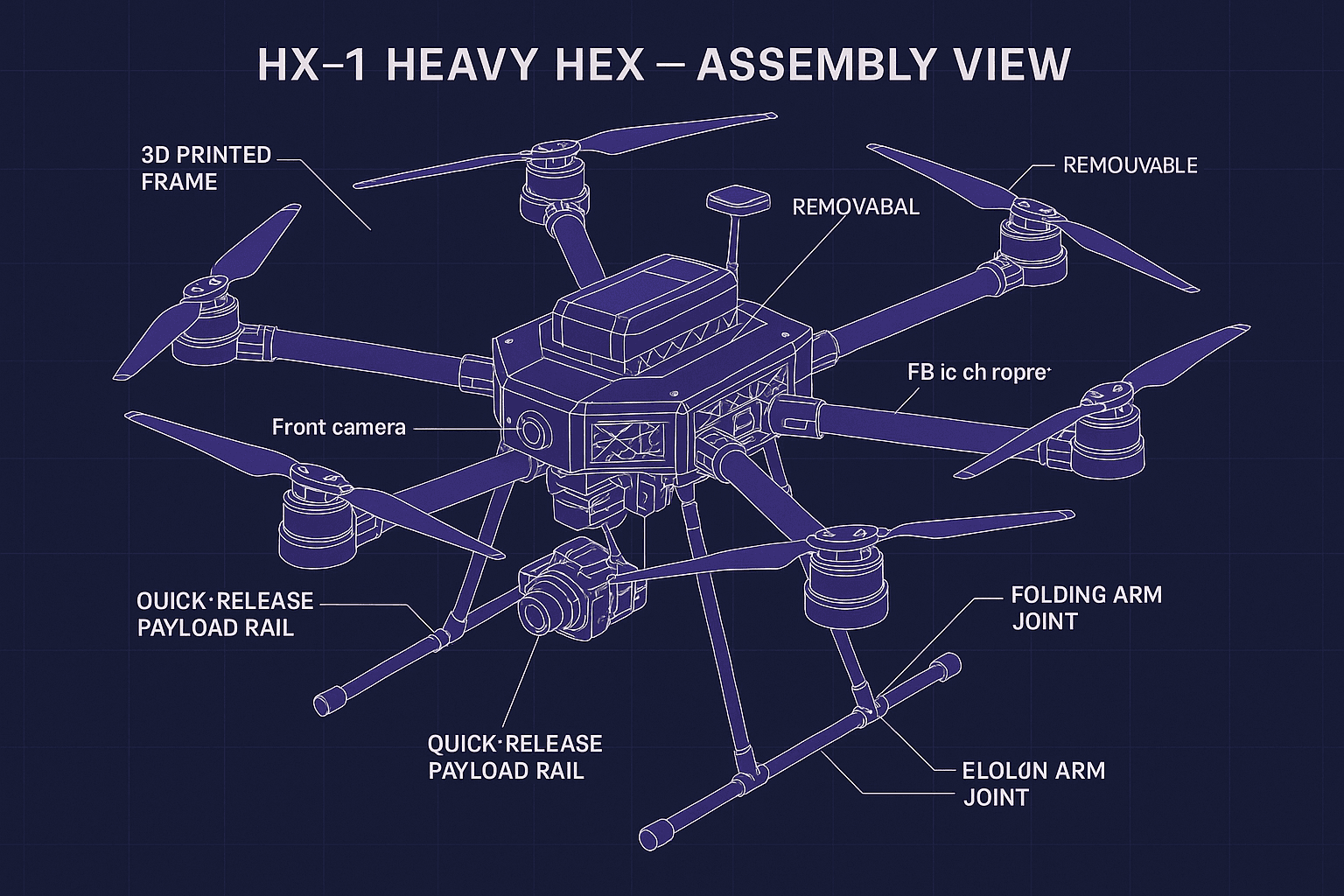
Folding arm design allows the entire platform to collapse to 60% of deployed size — fits in a standard Pelican 1510 carry-on case.
- 5
Arm geometry optimized for distributed assembly: each arm is an identical unit, 3D-printed with carbon fiber tube core reinforcement.
- 1
Quick-release payload rail on the underside center accepts standardized payload modules — swap in under 60 seconds without tools.
- 2
Low-profile body (80mm) keeps center of gravity stable under heavy payload. Payload mass sits close to the motor plane.
- 3
Landing gear provides 200mm of ground clearance — sufficient for most payload modules including gimbaled cameras and relay antennas.
- 4
Top-mounted battery bay accepts standard 6S 22,000mAh packs — hot-swap capable in field conditions. Multiple battery configurations supported.
- 5
Front-mounted gimbal attachment point is payload-agnostic: accepts EO/IR cameras, multispectral sensors, or custom sensor packages.
- 1
Primary frame components are designed for FDM 3D printing in PETG or ASA — standard materials available at any hardware store or online supplier.
- 2
Carbon fiber tube cores slide into 3D-printed arm housings — no machining required. Cut to length with a pipe cutter, press fit and secure with M3 hardware.
- 3
Total component count under 200 parts. A builder with basic electronics skills and a $300 3D printer can produce a complete airframe in under 20 hours.
- 4
All electronics (flight controller, ESCs, motors, GPS, receiver) are off-the-shelf components available from domestic suppliers — no foreign-only sourced parts required.
- 5
Assembly documentation includes step-by-step instructions, torque specifications, wiring diagrams, and pre-flight checklists. Designed to be followed without prior drone-building experience.
HX-1 — Full Specifications
Reference specification — subject to refinement through production validation pilots.
Non-Weaponized Platform
All systems produced through the Aedes Network are non-weaponized. The AR-7 is an ISR, communications, mapping, and logistics platform. The Disposable Aedes MD is a single-use autonomous delivery and sensor-deployment platform. The HX-1 is a heavy-lift ISR, communications, mapping, and logistics platform. Any use of Aedes-produced systems for weapons delivery, weapons integration, or prohibited applications is a violation of the Builder Network Agreement, the Aedes Terms of Service, and applicable federal law. Violations are referred to appropriate authorities. See our Compliance Policy and Regulatory Disclaimer.